
Mobile Fit Testing for Audit Ready Hearing Conservation in Australia

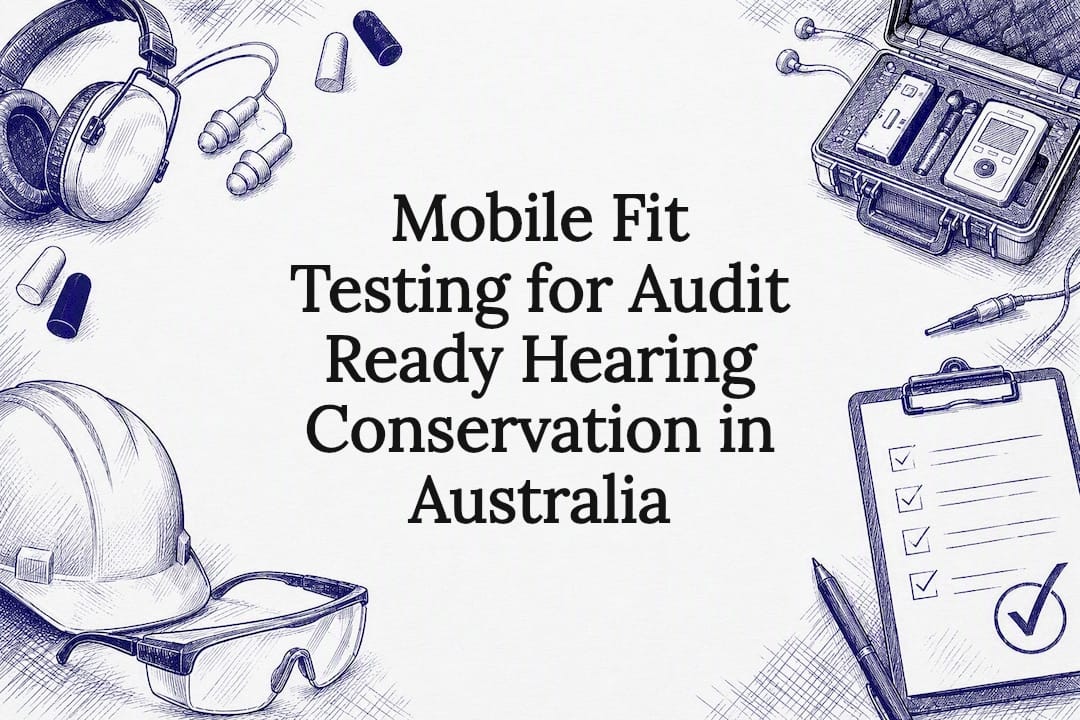
Under Australian WHS law, employers must ensure worker noise exposure doesn’t exceed LAeq,8h 85 dB(A) or LC,peak 140 dB©, measured at the ear without hearing protection factored in. If your workplace comes anywhere near those figures, the immediate step is to commission a qualified noise assessment and document what you decide to do about it. Everything else, from PPE selection to audiometric testing, flows from that one measurement.
TL;DR:
The noise standard applies universally, including for contractors and temporary workers, with baseline testing required shortly after exposure begins.
A comprehensive hearing conservation program requires risk assessment, hierarchy of controls, proper hearing protector selection, audiometric testing, and worker training.
Regular reassessment occurs after changes in plant, worker complaints, or incidents, with records maintained for compliance inspections.
Tailored training and on-site fit-testing are essential to ensure proper protector use and avoid common compliance gaps flagged by auditors.
Table of Contents
What are the legal hearing conservation requirements in Australia?
Every person conducting a business or undertaking (PCBU) has a primary duty under WHS law to eliminate noise risk where possible, or minimise it so far as is reasonably practicable when elimination isn’t an option. That duty doesn’t start and stop with handing out earmuffs. It covers how you assess the hazard, what controls you put in place, and how you prove you’ve done the work if a regulator comes knocking.
The exposure standard itself is precise: an eight hour equivalent continuous sound level (LAeq,8h) of 85 dB(A), or a peak C-weighted level (LC,peak) of 140 dB©, whichever is reached first. Crucially, this figure is measured at the worker’s ear position before any hearing protector is applied, as WorkSafe Victoria makes clear. You can’t justify a noisy plant by pointing to the earmuffs on the shelf. The exposure itself has to be brought under control.
Three sources set out what “control” looks like in practice:
The Safe Work Australia noise topic page and the national code of practice, which lay out hazard identification, the hierarchy of controls, and PPE selection and maintenance in detail.
State regulators such as SafeWork NSW and WorkSafe Victoria, which translate the model WHS Regulations into state-specific guidance and audiometric testing clauses.
The Australian Standards, principally AS/NZS 1270 for hearing protectors and the AS/NZS 1269 series for measurement and audiometric assessment.
The number that matters most: 85 dB(A) LAeq,8h. That’s roughly the noise of heavy city traffic experienced for a full working day, and it’s the line every risk assessment is measured against.
Recordkeeping and worker consultation aren’t optional extras bolted onto this framework, they’re part of the legal duty itself. Under the national code, you must consult workers on control measures and PPE selection, and keep evidence of assessments, training and test results available for review.
When is a hearing conservation program required?
You need a formal program the moment any one of these triggers appears in your workplace:
Measured exposure at or above LAeq,8h 85 dB(A), or a peak reading above 140 dB©.
Tasks that are obviously noisy even before you measure them, such as grinding, jackhammering, or operating heavy mobile plant.
Workers who are frequently required to wear hearing protection to control noise, which is the specific threshold that triggers mandatory audiometric testing under state WHS regulation.
That last point catches employers out more than any other. “Frequently required” doesn’t mean occasional or incidental PPE use, it means the role genuinely depends on hearing protectors to keep exposure under the standard. Labour hire workers, rotating FIFO crews, and contractors moving between host sites all need to be captured too, because the duty follows the worker’s actual exposure, not their employment arrangement. Baseline testing should happen shortly after that exposure starts, with periodic monitoring at regular intervals thereafter.
What are the core elements of a compliant program?
A hearing conservation program stands or falls on five components, and regulators expect to see evidence of all five, not just the PPE issue log.
Risk identification. A documented noise assessment that identifies which tasks, plant and areas exceed the exposure standard.
Hierarchy of controls. Work through elimination and substitution first, then engineering controls, then administrative measures, treating PPE as the last line of defence rather than the first.
Hearing protector selection and maintenance. Choose protectors compliant with AS/NZS 1270, matched to the actual attenuation needed, and maintain them on a schedule.
Audiometric testing. Baseline and periodic monitoring tests for anyone who frequently relies on hearing protection to manage noise exposure.
Training, signage and consultation. Workers need to understand why controls exist, how to use PPE correctly, and where mandatory hearing protection areas are signed under AS 1319.
Pro Tip: Run your five elements as a single annual cycle rather than five separate tasks. When the noise assessment, PPE review, and audiometric monitoring all land in the same quarter, you catch gaps in one control that another element would otherwise mask.
Skipping straight to earmuffs without documenting the earlier steps is the single most common compliance gap auditors flag, because it signals the hierarchy of controls was never genuinely considered.
How do you conduct a proper noise risk assessment?
A useful assessment goes further than a single sound level meter reading. It should capture LAeq,8h across a representative shift, LC,peak for any impact or impulse noise, and octave band analysis where the noise source is complex, such as mixed plant running simultaneously. Reassess whenever plant or processes change, after worker complaints, or following any incident involving hearing damage.
Who should run it? Someone with genuine competency in occupational noise measurement, not whoever happens to have a decibel app on their phone. Once you know where the problem sits, prioritise controls in this order:
Engineering controls, such as isolating noisy plant, fitting enclosures or mufflers, or specifying quieter equipment at purchase.
Administrative controls, including job rotation, scheduling noisy tasks for quieter periods, and clearly signed hearing protector areas.
Acoustic treatment of shared spaces, covered in detail by Niche Projects’ guide to office acoustics, shows how the same layering principle applies even outside industrial settings; quiet zones and sound absorption reduce reliance on PPE altogether.
What Australian standard applies to hearing protection?
AS/NZS 1270 governs the manufacture and performance rating of hearing protectors sold in Australia, and every protector you issue should carry a Sound Level Conversion (SLC80) rating or class rating under that standard. SafeWork NSW is blunt about this: don’t guess at protection levels, and involve workers in the selection process rather than issuing a single style across the whole site.
Selection needs to weigh more than the attenuation number on the box:
Match SLC80/class rating to the actual measured exposure, not a worst case guess.
Check comfort and wearability for full-shift use, since protectors that get pulled off after an hour offer no protection at all.
Confirm compatibility with other PPE, particularly hard hats, safety glasses and respirators.
Preserve communication and warning-signal audibility where the role demands it.
Over-protection is a genuine failure mode, not just a comfort issue. A worker wearing Class 5 earmuffs in an environment measured at 88 dB(A) can end up isolated from verbal warnings and reversing alarms, trading one risk for another.
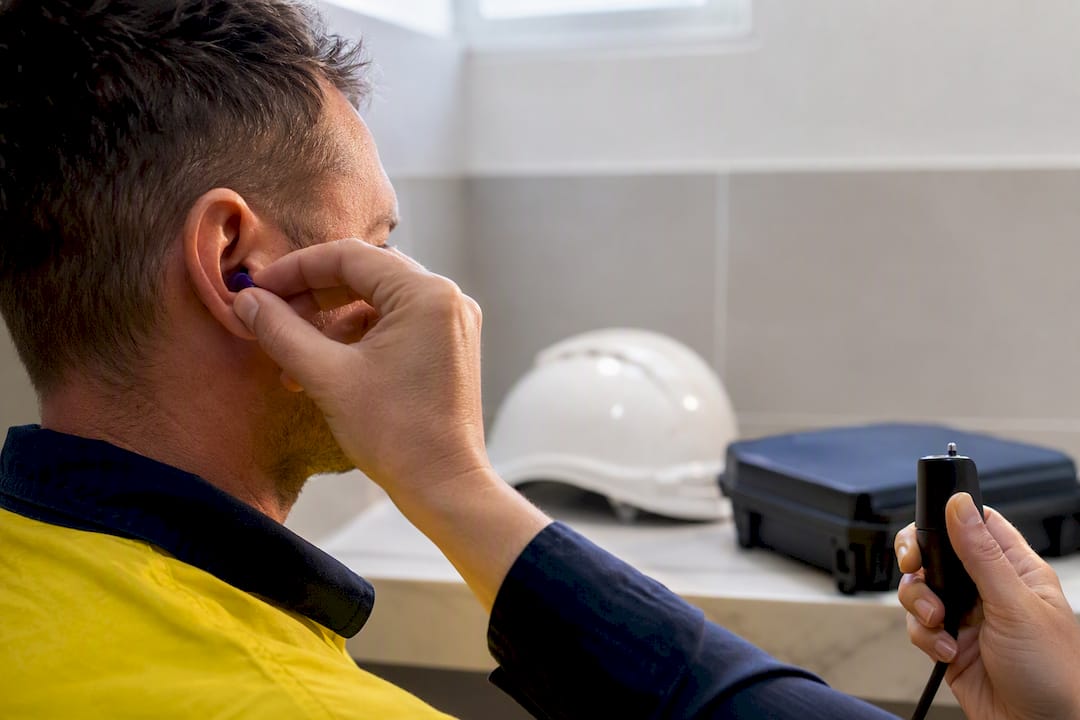
Pro Tip: A protector’s rated attenuation on the box rarely matches what a worker gets in the field. Field attenuation estimation (FAES) or on-site fit-testing measures real-world performance for that specific worker, which is exactly the gap mobile fit-testing services are designed to close for remote and FIFO crews.
Who needs audiometric testing and how often?
Anyone frequently required to wear hearing protection to control exposure above the standard has to be tested, and the employer pays for it, as SafeWork NSW sets out under clause 58 of the WHS Regulation.
The timing matters:
Baseline test shortly after the worker starts exposure to the hazard.
Monitoring tests at regular intervals, or more frequently where exposures are significantly above the standard.
Best practice timing: schedule monitoring tests part-way through a shift rather than at the very start, because testing mid-shift catches temporary threshold shifts that a first-thing-in-the-morning test will miss entirely.
If a test reveals a significant permanent threshold shift or a worker reports tinnitus, that’s a trigger to review your controls immediately, retrain the affected worker on correct PPE use, and refer them for medical assessment. Don’t file the result and move on; a threshold shift is evidence your program has a gap somewhere upstream of the test itself.
How do you evaluate and maintain program compliance?
Treat evaluation as a standing item, not a once off audit before a regulator visit. The 3M Centre for Hearing Conservation frames this as a structured checklist employers can run annually, and it holds up well against Australian requirements.
Records you need on file, ready to produce at short notice:
Noise assessments and any reassessment triggered by plant changes.
Hearing protector issue logs, matched to individual workers.
Audiometric test results, baseline and monitoring, for every worker covered.
Training attendance records and consultation notes.
Review trigger | What it should prompt |
Threshold shift on monitoring test | Review PPE fit, retrain worker, consider medical referral |
New plant or process installed | Fresh noise assessment before workers are exposed |
Worker complaint or near miss | Reassessment of the specific task or area |
Two years since last monitoring | Scheduled audiometric retest, on time, not overdue |
Worker involvement isn’t a courtesy here, it’s part of the legal consultation duty, and workers who help select their own protectors tend to wear them properly for longer.
Why tailored training closes the gap regulators actually check for
Most hearing conservation failures aren’t caused by employers ignoring the law, they’re caused by generic programs that don’t fit the actual workforce. A FIFO crew rotating through a Pilbara mine site has different exposure patterns to a fixed metro workshop, yet many programs treat both the same way.
On-site fit-testing and tailored training close that gap by verifying real attenuation for each worker’s actual protector, not the number printed on the packet, and by scheduling baseline audiometric testing at the point of induction rather than months later. Prime First Aid and Training builds this into mobile delivery for remote sites, so the paperwork trail exists from day one instead of being reconstructed after an audit. and would strengthen this further. However, the principle stands on its own: compliance built into onboarding survives scrutiny far better than compliance retrofitted after a complaint.
— Vapour
Book a fit test or tailored session with Primetraining
Some providers offer coordinated services including Hearing Protective Device fit testing, tailored on-site training, and audiometric support, so businesses can receive a fit-test report, training attendance records, and compliance paperwork in one visit rather than multiple.
Some providers operate in Port Hedland and across Western Australia and wider Australia by arrangement, which matters if your crew rotates through remote sites where flying in separate specialists isn’t practical. Browse our full course range to see what fits your workforce, or head straight to book online and lock in a session before your next audit or induction round.
Sources
FAQ
What are the five required elements of a hearing conservation program?
Risk identification through documented noise assessment, application of the hierarchy of controls, compliant hearing protector selection and maintenance, an audiometric testing schedule, and training with signage and consultation.
What is the Australian standard for hearing protection?
AS/NZS 1270 governs hearing protector performance and attenuation ratings, expressed as SLC80 or class ratings, while the AS/NZS 1269 series covers noise measurement and audiometric assessment procedures.
Who is required to be in a hearing conservation program?
Any worker exposed to noise at or above LAeq,8h 85 dB(A) or LC,peak 140 dB©, or anyone frequently required to wear hearing protection to control exposure, including labour hire and rotating contract workers
What triggers a hearing conservation program?
A measured exposure at or above the standard, inherently noisy tasks, or a workforce that relies on hearing protectors frequently enough to meet the audiometric testing threshold under state WHS regulation.
Recommended
Comments