
Employers: 6 Site Details Make First Aid Training Risk Assessment Work

A training risk assessment for first-aid delivery identifies every site hazard that could affect the course, then sets the exact controls and content adaptations the trainer must apply before anyone practises CPR on a workshop floor. The single action to take now is simple: send the trainer your site hazards and book a pre-site check or a detailed site brief before delivery day. A tailored provider such as Prime First Aid and Training builds the session around what your workplace actually looks like, not a generic slide deck.
TL;DR:
Providing detailed site maps and hazard lists before booking allows trainers to customize scenarios, especially for confined spaces, hazardous substances, or remote locations.
A collaborative site-specific risk assessment ensures hazards are rated and controls are applied systematically, reducing on-the-day improvisation and increasing safety.
Equipment checks, credentials verification, and infection control measures protect trainers and learners, especially when shared resources or challenging environments are involved.
Tailored courses that adapt scenarios, equipment, and pacing to the actual site environment lead to more effective and safer first-aid training.
Comprehensive documentation of hazard controls, responsibilities, and verification keeps training compliant and defensible in case of audits or incidents.
Table of Contents
Checklist: what to prepare and send the trainer before delivery
Generic templates fall over the moment a site has confined spaces, hazardous substances, or a location three hours from the nearest hospital. Employers must communicate these details before booking so the trainer can build a session that fits, rather than adapt on the fly once everyone’s already standing on the workshop floor.
Send the trainer this before your session is confirmed:
Site map, access and egress points, parking arrangements and any site induction requirements
A list of tasks and hazardous activities performed on site, including hazardous substances and confined spaces
Participant numbers, languages spoken, known medical conditions, and PPE requirements
Equipment availability: power points, flat clean surfaces for CPR practice, and whether an AED is already on site
Distance and contact details for the nearest emergency services, plus site communications (radio, mobile blackspots)
Permits or isolation requirements that affect the training space, such as hot work permits or permit-to-work zones
The more of this the trainer has before arrival, the less time gets spent working it out on the day.
Step-by-step site-specific training risk assessment workflow
A proper training risk assessment isn’t a form filled in from memory. It’s a collaborative process between host and trainer that runs in a defined order, each step building on the last.
Pre-site information review. The trainer requests site maps, hazard registers and participant details; the host supplies them before delivery, not on the morning of.
Walk-through checklist. Either in person or via detailed site brief, check the space, flooring, ventilation, lighting, power availability, trip hazards, and access and egress routes, along with any hazards in adjoining areas.
Activity hazard check. Training itself introduces risk. CPR practice on a concrete or gravel floor, a crowded breakout room during scenario drills, or an AED trainer near live equipment all need a second look.
Simple risk rating. Rate each hazard on likelihood and severity, low, medium or high, and flag anything landing in the “must address before delivery” band.
Apply the hierarchy of controls. Eliminate the hazard where possible (move the session to a cleared area), substitute (use mats instead of bare concrete for CPR practice), isolate (fence off the training zone from live work), apply administrative controls (staggered group sizes, supervised movement), and use PPE as the last line, not the first.
Record it. Every agreed modification goes into the risk control plan, with who owns it and when it was checked.
Pro Tip: Don’t assume a trainer’s general liability insurance covers site-specific risks like a contaminated floor or a confined practice space. Ask what controls they’ve agreed to in writing before the session, not after.
Collaborative assessment between the trainer and host closes a common gap: training delivered somewhere low-risk when the skills will actually be used somewhere far riskier, according to commentary on ASQA’s draft guidelines.
Tailoring course content to your site and your people
A session designed for an office won’t hold up on a mine site or in a childcare centre, and a good trainer changes the scenarios, not just the slides, to match.
Remote or isolated sites get extended response-time scenarios, since help might be an hour away rather than five minutes.
Confined-space environments get simulations adapted to tight, low-light conditions rather than an open training room.
Sites with hazardous substances get casualty management scenarios that factor in chemical exposure alongside the standard first-aid response.
Limited space means scaled-down practical drills, smaller groups rotating through stations instead of everyone on the floor at once.
Some sites warrant a specialised module altogether, such as remote or isolated-site first aid or manual-tasks training where physical risk is part of the job. Hazard assessments should also weigh learner characteristics, age, language, experience, when choosing controls and how competency gets assessed, per CDU’s OHS training guidance. Where space genuinely limits realistic practice, the trainer documents the alternative method used to demonstrate competency and gets it signed off, so the certificate still holds up under scrutiny.
What the risk control plan needs and who signs off
Documentation isn’t paperwork for its own sake. It’s the evidence that a hazard was identified, assessed and controlled, and it’s what an auditor or WHS rep will ask to see if anything goes wrong.
A usable risk control plan includes:
Every identified hazard, its assessed risk rating, and the control chosen for it
The person responsible for each control and the date it was confirmed
Verification steps, how and when the control was checked as working
Sign-off from the trainer, the site’s WHS representative, and the site supervisor before delivery starts
A note on who monitors conditions during the session and how an incident gets escalated on the day
This record should stay alive after the course ends, feeding into the next booking rather than getting filed and forgotten. A living system, pre-verification, ongoing monitoring, and post-delivery review, is what current RTO expectations for site-based training actually call for, according to CAQA’s analysis of the risk management gap.
Checking the trainer is ready before they walk in
The risk assessment isn’t only about your site. It’s also a check on whether the trainer and their gear are actually fit for the conditions you’re putting them into.
Ask for the trainer’s credentials and relevant industry experience, mining, construction, healthcare, whatever matches your setting.
Confirm the equipment list: cleanable manikins, AED trainers, cleaning supplies, spare PPE, and hand sanitiser.
Check infection control steps are in place between practical stations, particularly shared equipment like manikins.
Request evidence of the provider’s documented procedures, insurance, and prior experience delivering site-specific sessions.
ASQA expects registered training organisations to show fit-for-purpose, safe and sufficient facilities and equipment as standard practice, and asking for this evidence upfront is a fair, reasonable request of any provider.
Pro Tip: If a provider can’t tell you how they clean shared manikins between groups, that’s a red flag worth pressing on before you confirm the booking.
Common site-specific hazards across industries
The hazards that matter change completely depending on where the training happens, and a one-size checklist misses most of them.
On a mine site or industrial yard, dust, heavy vehicle movement, and isolation from emergency services all shape how a scenario should run. Construction sites bring height risks, manual handling loads, and noise that can drown out instructions during a drill. Healthcare and aged care settings introduce infection control demands and confined treatment rooms where realistic CPR practice space is tight. Childcare and education settings need lower furniture, smaller practice areas, and scenarios built around paediatric first aid rather than adult casualty management. Office environments, often assumed to be low-risk, still carry trip hazards from cabling, limited floor space for group practice, and poor ventilation in smaller meeting rooms used for training.
Remote and fly-in fly-out sites add another layer entirely: extended time to definitive care, patchy communications, and environmental extremes like heat stress that affect both the casualty in a scenario and the participants practising it. A hazard checklist built for a suburban office will miss almost all of this, which is exactly why generic templates keep failing sites with genuine operational risk.
Emergency response planning for the training session itself
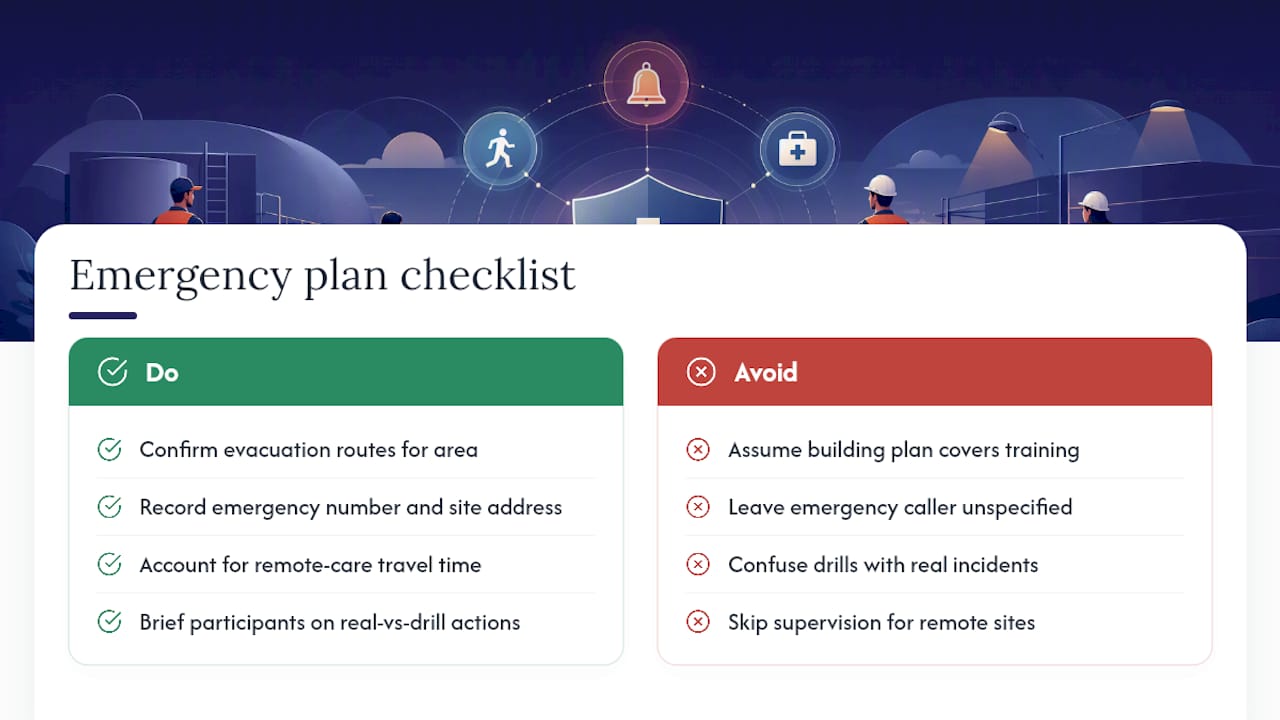
Every training session needs its own emergency plan, separate from the workplace’s existing one, because the risks introduced by the training activity aren’t always covered by standard site procedures.
That means confirming evacuation routes from the specific room or area being used, not just the building generally. It means knowing who calls emergency services if a real incident happens during a practical drill, and having that number and the site address written down, not assumed. If the site is remote, the plan needs to account for the actual time to reach definitive care, and adjust supervision and response scenarios accordingly.
The trainer should also brief participants at the start of the session on what to do if a genuine incident interrupts the training, distinct from the simulated scenarios they’re about to practise. This matters more than it sounds. Confusion between a real event and a training drill has caused delayed responses in workplaces before, and a thirty-second briefing at the start of the session removes that risk entirely.
Legal and regulatory standards behind training risk assessments
Registered training organisations don’t get to treat facilities and risk management as optional extras. ASQA’s Standard 1.8 requires demonstrable evidence that facilities, resources and equipment are fit-for-purpose, safe and sufficient, and that providers actively monitor and correct issues when they’re not, under the ASQA practice guide for facilities, resources and equipment.
For specific first-aid units like HLTAID016, where practical constraints limit full simulation, trainers are required to document the alternative method used to confirm competency, backed by site sign-off, according to Training. This isn’t a box-ticking exercise. It’s what keeps a certificate defensible if a participant’s competency is ever questioned.
Practical checklists trainers actually use on site
The tools that make a training risk assessment work aren’t complicated. A one-page hazard checklist covering walkways, signage, evacuation points and surface suitability for practical activities like CPR is the baseline, based on hazard checklist examples used in TAFE NSW’s WHS risk assessment guidance.
Beyond the checklist, a simple risk matrix scoring likelihood against severity helps prioritise what needs fixing before delivery versus what can be monitored on the day. A site brief template, filled in by the host before the trainer arrives, saves the walk-through from becoming guesswork. And a sign-off sheet, naming who confirmed each control and when, turns the whole process into evidence rather than memory.
Frequent mistakes and how a tailored provider avoids them
The same mistakes show up repeatedly. Providers lean on a generic risk template that never gets adjusted for the actual site. Hosts skip the pre-site check because it feels like an extra step, then discover on the day that the training room has no flat surface for CPR practice. Learning-space comfort, lighting, ventilation, temperature, gets treated as a nice-to-have rather than a factor that affects both safety and how well people actually absorb the training.
Mobile providers who run pre-delivery walk-throughs, or at minimum work from a detailed site brief, consistently produce more relevant scenarios and safer sessions. It’s the difference between a trainer who’s seen your loading dock and one who’s guessing what “industrial site” means. That gap shows up in how confidently participants respond when a scenario suddenly feels close to something they’ve actually seen at work.
— Vapour
Book a tailored on-site or remote first-aid session
Tailored providers offer alternatives to generic, one-size courses for sites with real operational hazards, remote locations, confined spaces, or industrial risks that a standard template simply doesn’t account for. Instead of adapting a stock slide deck on the day, sessions are built around your site brief before the trainer arrives, so the scenarios, equipment and pacing match what your team actually faces.
Before booking, have your site map, participant numbers, and known hazards ready to send through. That’s what turns a generic booking into a properly tailored one. On-site, mobile and remote-site first-aid modules, including Provide First Aid in Remote or Isolated Site for teams working away from easy access to emergency care, with certification issued upon course completion, are available. Browse the full range of courses to match the training to your site, or head straight to book online and get a delivery date locked in.
Sources
For readers who need to check compliance detail or design their own site procedures, these are the primary documents worth keeping on file:
FAQ
What Is a Training Risk Assessment for First Aid?
It’s a process that identifies site-specific hazards affecting a first-aid course, then sets the controls and content adaptations the trainer needs to deliver it safely, covering everything from floor surfaces for CPR practice to remote-site response times.
Who Should Supply Site Hazard Information to the Trainer?
The host employer, usually the safety manager, HR contact, or team leader booking the session, should supply site maps, hazard lists, and participant details before the trainer arrives, ideally through a pre-site check or detailed brief.
What Happens if Practical Space Is Too Limited for Full Simulation?
The trainer documents an alternative method used to confirm competency and gets site sign-off, ensuring the assessment stays valid even when realistic practice space is constrained.
Can Primetraining Adapt a Course for a Remote or Industrial Site?
Yes. Tailored on-site, mobile and remote-site first aid modules, including courses built specifically for remote or isolated-site first aid, can be adapted based on the hazard information the host provides before delivery.
Recommended
Comments