
A one-day HLTAID011 face-to-face course commonly runs 7.5 to 9.5 hours once you factor in breaks and assessment. Choose the blended option and you’re looking at roughly 4.75 to 5 hours of face-to-face time after finishing pre-learning online. A standalone CPR course under HLTAID009 usually takes 2 to 2.5 hours. Certificates commonly last three years, though exact validity should be confirmed with providers and workplace policies., so build a small time buffer into whichever session you book.
TL;DR:
A standard face-to-face first aid course typically lasts between 7.5 and 9.5 hours, depending on practical and assessment components.
Blended courses with online pre-learning require about 4.75 hours of face-to-face time, roughly half the duration of traditional classroom sessions.
Duration varies based on syllabus complexity, practical scenarios, assessment time, pre-learning, and whether delivery is virtual or in-person.
Expect to add 30 to 90 minutes for setup, buffers, and to accommodate group differences, especially for new providers or incomplete pre-learning.
Certificates are valid for three years, but CPR refreshers often need annual updates due to skills decay, requiring ongoing scheduling.
Table of Contents
First aid course duration by unit and delivery mode
Course duration questions almost always come back to two things: which unit you’re completing, and how it’s delivered. Get clear on both and the scheduling puzzle solves itself.
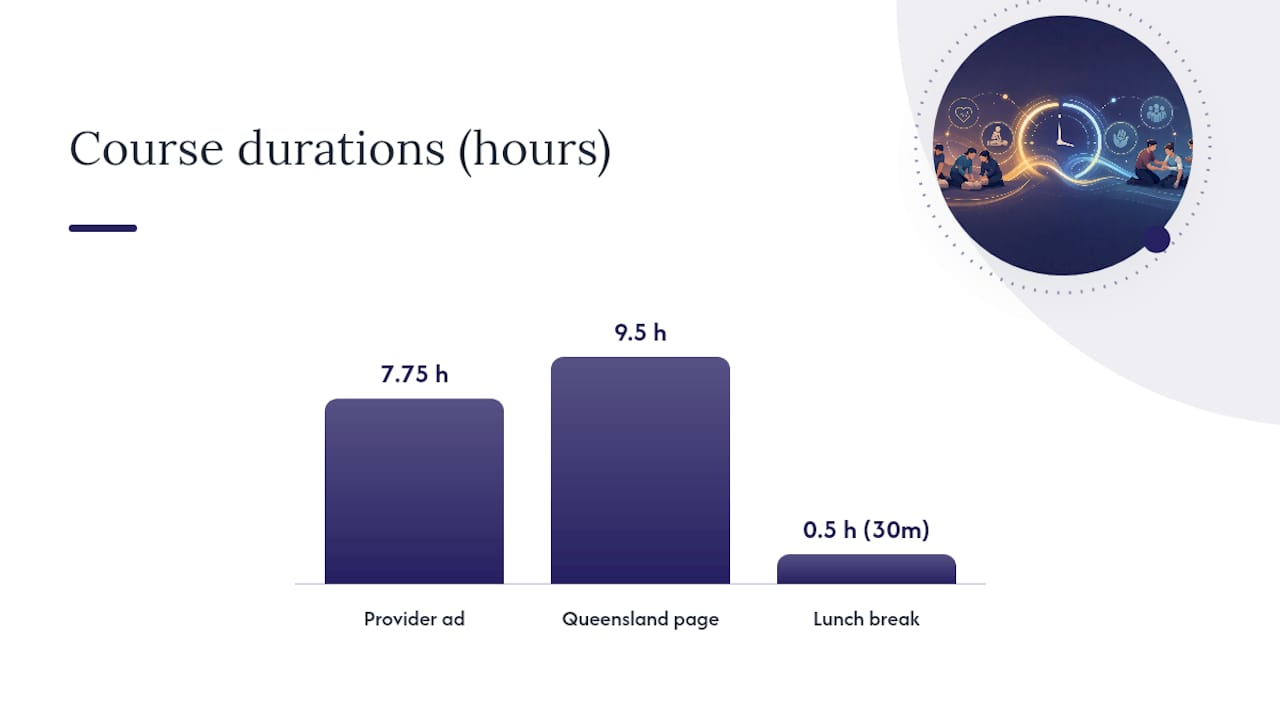
HLTAID011 Provide First Aid, the standard workplace unit, is where most of the confusion sits. Some providers advertise a 7.75-hour day; Queensland’s government course page lists 9.5 hours inclusive of a 30-minute lunch break, and notes sessions may run over to meet students’ needs. Neither figure is wrong. The gap comes down to how much time a provider builds in for practical scenarios and one-on-one assessment.
Blended delivery changes the equation. St John Ambulance Victoria’s HLTAID011 page lists face-to-face time at around 4.75 hours once participants complete the theory component online beforehand, with a similar timeframe for virtual classroom delivery. That’s roughly half the classroom time of the full-day format, because the reading and knowledge checks happen before anyone walks in the door.
For CPR-only training under HLTAID009, expect a shorter, sharper session:
Standard CPR/CPR-AED classes typically run 2 to 2.5 hours, according to Red Cross CPR class guidance.
Blended CPR still requires an in-person skills check, so a fully online CPR certificate doesn’t exist in practice.
Some community-focused “complete first aid” courses, as described by Australian Red Cross, run closer to 6 hours, sitting between a CPR-only session and the full HLTAID011 day.
Unit codes matter here because they’re not just paperwork. Training sets the syllabus and assessment requirements that every registered training organisation must follow, which is why HLTAID011 and HLTAID009 carry different minimum contact hours regardless of who’s delivering them. If you’re comparing quotes and one provider’s HLTAID011 day is markedly shorter than another’s, ask what’s been trimmed.
Why course length varies: syllabus, practicals and assessment
Every hour in a first aid course is doing a job. Strip away the content and the reasons for the time difference become obvious.
Core syllabus delivery. HLTAID011 covers DRSABCD, CPR, choking, bleeding control, anaphylaxis, and a growing list of medical emergencies. Working through each topic with enough context to be usable, not just memorised, takes real classroom time.
Practical scenario work. Trainers run simulated emergencies so participants practise decision-making under mild pressure, not just technique in isolation. This is where a lot of the “why is my session longer than advertised” time goes.
Individual assessment and skill demonstration. Every participant needs to be observed performing CPR and other practical skills to a competent standard. In a group of 15 to 20, that observation time adds up fast, and it’s non-negotiable for certification.
Pre-learning in blended models. The theory, quizzes, and knowledge checks that would otherwise eat classroom hours get shifted online before the face-to-face session, which is exactly why blended HLTAID011 delivery can run in under five hours.
Virtual classroom verification. Remote delivery still needs a way to confirm practical competency, whether that’s a supervised video check or a follow-up in-person session, and that verification step has its own time cost.
Once you see the structure this way, the difference between a “quick” course and a “long” one stops looking arbitrary.
What makes training run longer or shorter than planned
Course durations on a brochure are a starting point, not a promise. Several predictable factors push actual session time up or down.
Group composition. A cohort with mixed experience, limited English, or a slower learning pace needs more repetition of practical skills.
Pre-learning completion. When a chunk of the group hasn’t finished the online theory, trainers often have to re-teach it in person, turning a short blended session into something closer to a full day.
Custom workplace content. Scenarios built around your specific site, whether that’s a warehouse floor or a remote mine camp, add relevance but also add time.
Trainer approach and equipment. Extra time spent on questions, equipment faults, or re-running a failed skill demonstration all extend the clock.
Pro Tip: Add 30 to 90 minutes of buffer to whatever the course listing says, especially for a first booking with a new provider or a group that hasn’t done pre-learning before. It’s far easier to release people early than to explain why the session ran into their next meeting.
A scheduling checklist for booking training without surprises
A little upfront confirmation saves a lot of afternoon chaos. Before you lock in a date, work through this:
Confirm the delivery mode and pre-learning requirement directly with the provider, since “one-day course” can mean 7.5 hours or 9.5 hours depending on how it’s structured.
Set a pre-work deadline for blended participants, and run a quick tech check for anyone joining a virtual classroom component.
Reserve setup and pack-down time on top of the advertised course length, plus a genuine assessment buffer, not just the bare minimum.
Avoid stacking other commitments immediately after training, particularly for a full-day HLTAID011 session that Queensland’s own guidance flags as one that may run over.
As a rough template: half-day blended HLTAID011 needs about 5 hours plus setup, a full face-to-face day needs 8 to 10 hours including lunch, and a standalone CPR session needs roughly 2.5 to 3 hours all-in.
How long does a first aid certificate last?
A completed HLTAID011 certificate is generally valid for three years, though it’s worth confirming the exact figure with your provider and checking your own workplace policy, since some employers set shorter internal cycles.
CPR competency doesn’t hold up nearly as well over that timeframe. Skills like chest compression depth and rate decay faster than most people expect, which is why many workplaces run annual CPR refreshers even though the full certificate is still current.
Full HLTAID011 certificate: commonly three years.
CPR-specific refresher: often annual, regardless of the full certificate’s expiry.
Short blended refreshers can sit between full renewals, keeping compliance current without repeating the entire syllabus.
Always check Safe Work Australia’s guidance or your specific state regulator for exact recertification obligations, since these can differ by industry.
How tailored delivery changes the time equation
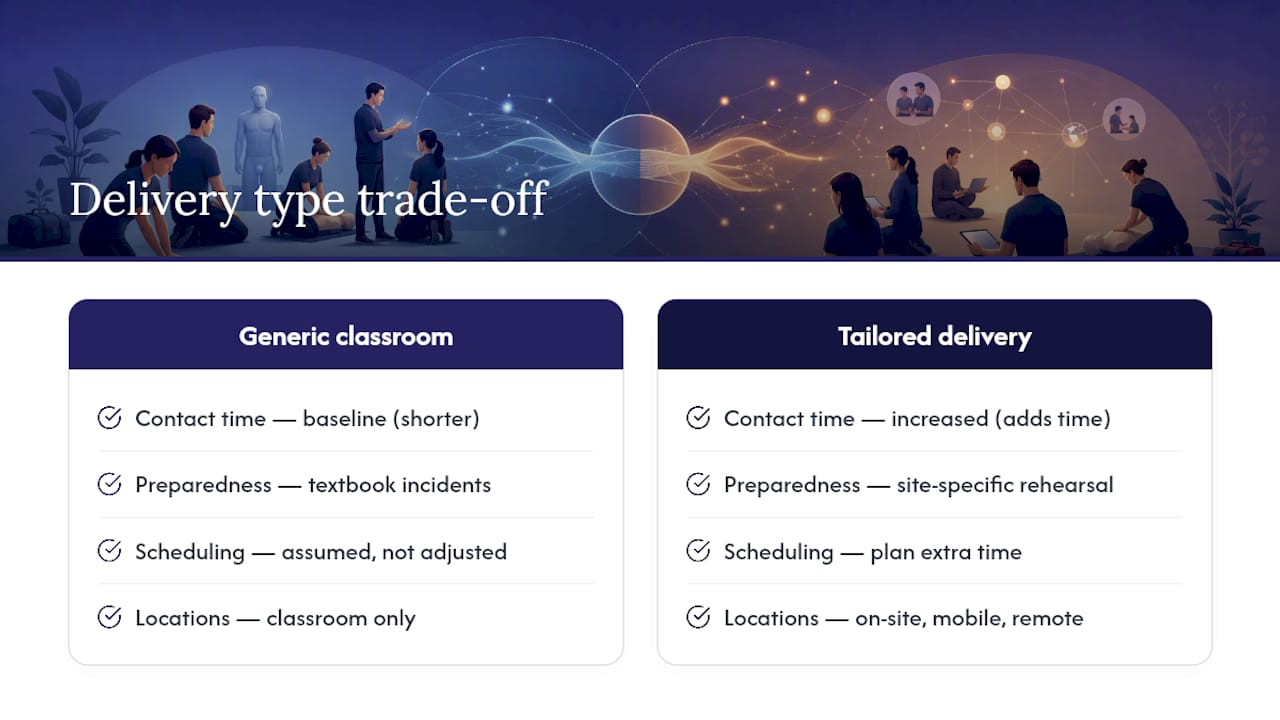
Standard timings are a useful baseline, but they assume a generic classroom. In our experience running sessions on-site, mobile, and at remote locations including Pilbara mine sites, the honest answer is that customisation adds contact time. Building scenarios around a specific worksite, its equipment, and its actual emergency risks takes longer than reading from a generic slide deck.
That extra time buys something worth having: a group that’s genuinely rehearsed for the incidents they’re likely to face, not just the textbook version. We treat that trade as worthwhile, and we schedule for it rather than pretending it doesn’t exist.
— Vapour
Book training that fits your timeframe, not the other way around
There are alternatives to generic public courses that offer on-site, mobile, and blended sessions scheduled to fit team rosters, with certificates issued promptly after assessment to avoid delays in paperwork following the training day.
Start by confirming which unit you actually need. If it’s the standard workplace certificate, check the Provide First Aid course details for what’s involved. If your team only needs the resuscitation component refreshed, the Provide CPR course covers that on its own shorter timeframe. Either way, confirm your pre-learning requirements before the date is set, then head to our courses page to request a quote or book online directly for your group.
Where to confirm exact course times
For the most current runtimes and unit requirements, check training.gov.au for the official HLTAID011 and HLTAID009 unit details, and Safe Work Australia’s code of practice for workplace training obligations. Always confirm exact session length with your chosen provider before booking.
Sources
Recommended